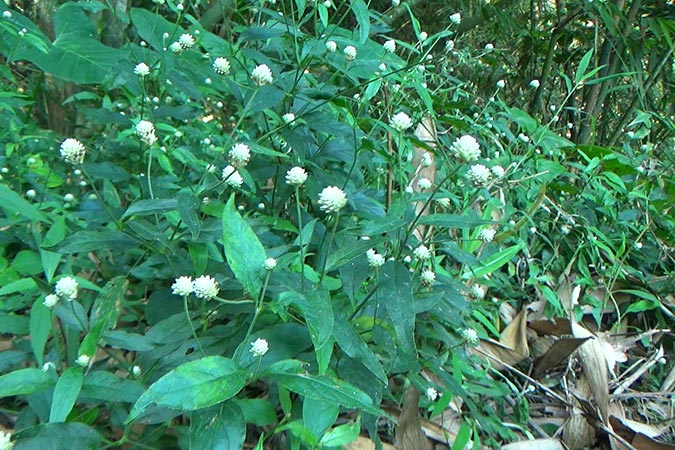
Yellow joyweed (Alternanthera flavescens) is a plant species in Amaranthaceae, perennial shrub, upright, 60-150 cm tall, rounded stems, long slender, spread upward, branching to form a trident, the tip ends with flowers, green with whitish scales.
A. flavescens have oval or lancet or elliptical or long leaves, in pairs, 1.8-8 cm long, 0.5-3 cm wide, herbaceous, hairless or hairy, a bone in the middle with several pulses, shiny, surface the top is dark green and the lower surface is pale green.
Flowers in the inflorescence and axillary terminals. Yellowish white head, subglobose to cylinder, length 0.9-2.5 cm, width 0.9-1 cm. Monomorphic tepal, green, lanceolate, 3.4-4.7 mm, acute peak, villi and non-thorny.
Yellow Joyweed has five stamens, pseudostaminodes ligulate and margin laciniate. Utrikel included in tepal, greenish yellow, ellipsoid and size 2.5 mm. The seeds are ovoid and 1.2-1.3 mm in size.
This species blooms throughout the year, grows into shrubs and spreads covering primary and secondary forest floors, waterways, roadside, agricultural land, abandoned lands and shady places.
TAXON
Kingdom: Plantae
Phylum: Tracheophyta
Subphylum: Angiospermae
Class: Magnoliopsida
Order: Caryophyllales
Family: Amaranthaceae
Subfamily: Gomphrenoideae
Genus: Alternanthera Forssk. in Fl. Aegypt.-Arab.: 28 (1775)
Species: Alternanthera flavescens Kunth in F.W.H.von Humboldt, A.J.A.Bonpland & C.S.Kunth, Nov. Gen. Sp. 2: 207 (1818)
HOMOTYPIC SYNONYMS
Gomphrena brachiata Humb. & Bonpl. ex Schult. in J.J.Roemer & J.A.Schultes, Syst. Veg., ed. 15[bis]. 5: 542 (1819)
Mogiphanes flavescens (Kunth) Mart. in Nov. Gen. Sp. Pl. Bras. 2: 36 (1826)
Telanthera flavescens (Kunth) Moq. in A.P.de Candolle, Prodr. 13(2): 382 (1849)
Illecebrum flavescens (Kunth) Spreng. in Syst. Veg., ed. 16. 1: 819 (1824)
HETEROTYPIC SYNONYMS
Achyranthes capituliflora Bertero ex Colla in Hortus Ripul.: 4 (1824)
Achyranthes dioica Pav. ex Moq. (1849)
Alternanthera capituliflora (Bertero ex Colla) Schinz in H.G.A.Engler, Nat. Pflanzenfam., ed. 2. 16c: 76 (1934)
Alternanthera coriacea Herzog in Meded. Rijks-Herb. 46: 7 (1922)
Alternanthera floridana (Chapm.) Small in Fl. S.E. U.S.: 396 (1903)
Alternanthera praelonga var. australis Pedersen in Adansonia, sér. 3, 19: 222 (1997)
Alternanthera scandens Hallier f. in Meded. Rijks-Herb. 46: 7 (1922)
Telanthera brasiliensis f. capitata Chodat in Bull. Herb. Boissier, sér. 2, 1: 433 (1901)
Telanthera capituliflora (Bertero ex Colla) Moq. (1849)
Telanthera floridana Chapm. in Fl. South. U.S.: 383 (1860)
PUBLICATIONS
Acevedo-Rodríguez, P. & Strong, M.T. (2012). Catalogue of seed plants of the West Indies. Smithsonian Contributions to Botany 98: 1-1192.
Baksh-Comeau, Y., Maharaj, S.S., Adams, C.D., Harris, S.A., Filer, D.L. & Hawthorne, W.D. (2016). An annotated checklist of the vascular plants of Trinidad and Tobago with analysis of vegetation types and botanical 'hotspots'. Phytotaxa 250: 1-431.
Bayón, N.D., Giuliano, D.A. & Bahima, J.V. (2022). Revisión taxonómica de las especies de Alternanthera (Amaranthaceae) del cono sur (Argentina, sur de Brasil, Chile, Paraguay y uruguay) y Bolivia. Annals from the Missouri Botanical Garden 107: 160-249. MBG press.
Flora of North America Editorial Committee (2003). Flora of North America North of Mexico 4: 1-559. Oxford University Press, New York, Oxford.
Govaerts, R. (1995). World Checklist of Seed Plants 1(1, 2): 1-483, 529. MIM, Deurne.
Hokche, O., Berry, P.E. & Huber, O. (eds.) (2008). Nuevo Catálogo de la Flora Vascular de Venezuela: 1-859. Fundación Instituto Botánico de Venezuela.
Jørgensen, P.M. & León-Yánez, S. (eds.) (1999). Catalogue of the Vascular Plants of Ecuador. Monographs in Systematic Botany from the Missouri Botanical Garden 75: i-viii, 1-1181. Missouri Botanical Garden.
Jørgensen, P.M., Nee, M.H. & Beck., S.G. (eds.) (2013). Catálogo de las plantas vasculares de Bolivia. Monographs in Systematic Botany from the Missouri Botanical Garden 127: 1-1741. Missouri Botanical Garden.
Muer, T., Sauerbier, H. & Cabrara Calixto, F. (2020). Die Farn- und Blütenpflanzen Madeiras: 1-792. Verlag und Versandbuchhandlung Andreas Kleinsteuber.
Sánchez-del Pino, I., Espadas, C. & Pool, R. (2013). Taxonomy and richness of nine genera of Amaranthaceae s.s. (Caryophyllales) in the Yucatan peninsula biotic province. Phytotaxa 107: 1-74.
Villaseñor, J.L. (2016). Checklist of the native vascular plants of Mexico. Revista Mexicana de Biodiversidad 87: 559-902.
Zuloaga, F.O. & Belgrano, M.J. (eds.) (2020). Flora Argentina. Flora vascular de la República Argentina 19(1): 1-378. INTA, IMBIV & IBODA.
Zuloaga, F.O., Morrone, O. , Belgrano, M.J., Marticorena, C. & Marchesi, E. (eds.) (2008). Catálogo de las Plantas Vasculares del Cono Sur. Monographs in Systematic Botany from the Missouri Botanical Garden 107: 1-3348. Missouri Botanical Garden.
VERNACULAR NAME
Armenian: Ալտերնանթեր դեղին
English: Yellow joyweed
Indonesia: Benikan
Java: Benikan
Russian: Альтернантера желтеющая
Spanish: Amor seco del monte
Aryo Bandoro
Dlium TheDlium
YouTube: https://www.youtube.com/@Dlium
Comments
Post a Comment